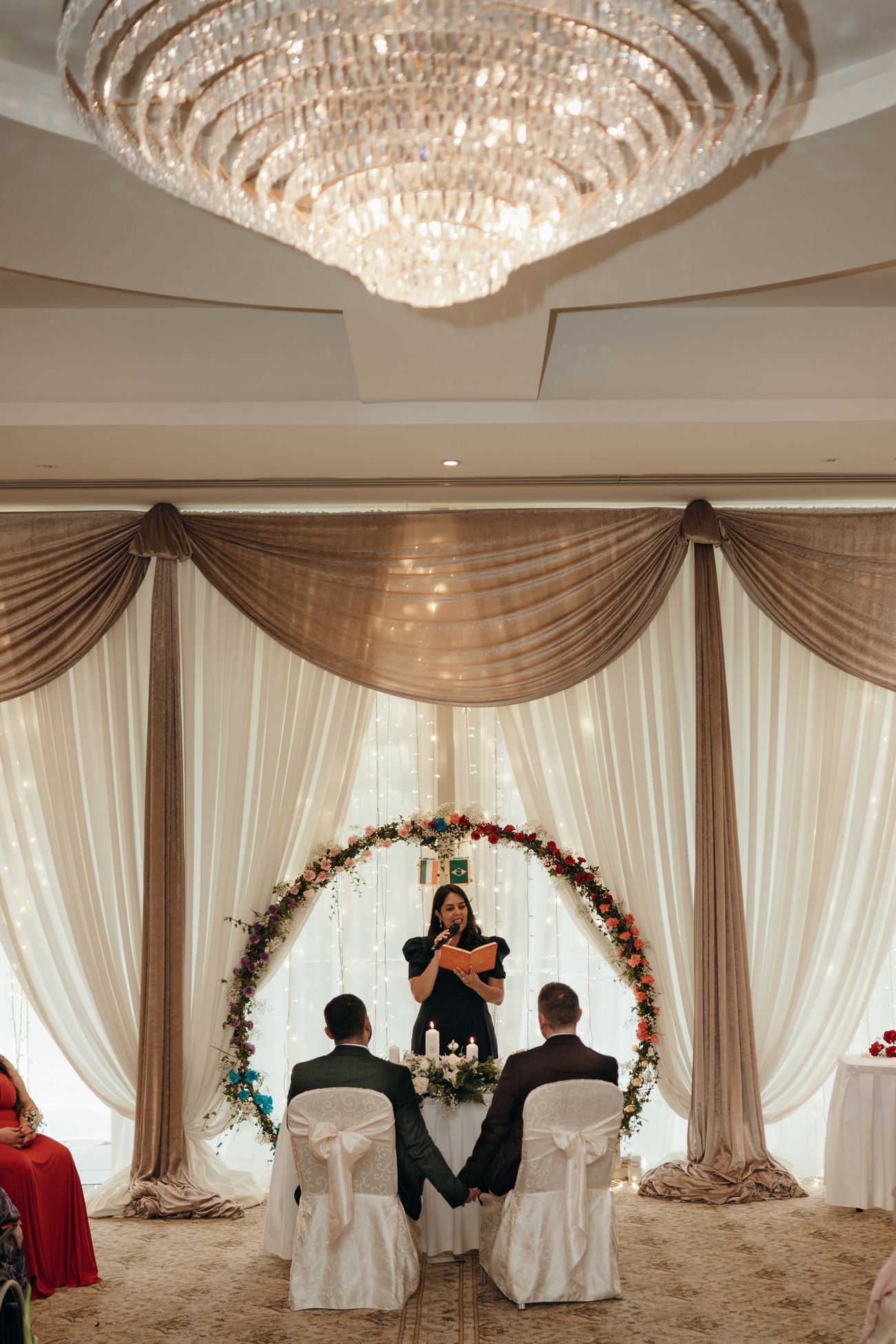
Every venue in Ireland can legally say "we welcome same-sex weddings." (That's the exact phrase they use — it's the legal-friendly one that ticks the compliance box without meaning much.) Since the Marriage Act 2015, they can't refuse you. But being legally forced to accept your booking and being genuinely happy that you chose them — those are very different things.
This guide is about the second one. Because the venue is where everything else happens — the ceremony (if you go civil or Humanist), the meal, the dancefloor. It's the day. And you deserve staff who are rooting for you, not just tolerating you.
Here's how to tell the difference — from the first email to the final walkthrough.
Todo venue na Irlanda pode legalmente dizer "acolhemos casamentos same-sex". (Essa é a frase exata que eles usam — a versão legalmente friendly que preenche a caixinha de conformidade sem significar muita coisa.) Desde o Marriage Act 2015, não podem recusar vocês. Mas ser obrigado por lei a aceitar a reserva e ser genuinamente feliz que vocês escolheram esse lugar — são coisas muito diferentes.
Esse guia é sobre a segunda. Porque o venue é onde tudo mais acontece — a cerimônia (se for civil ou Humanista), a refeição, a pista de dança. É o dia inteiro. E vocês merecem uma equipe torcendo por vocês, não só tolerando.
Aqui é como saber diferenciar — do primeiro email até o walkthrough final.
01 · The legal groundWhat Irish law protects
Ireland has some of the strongest LGBTQ+ protections in Europe. When it comes to venues, three pieces of law matter:
- Marriage Act 2015 — legalised same-sex marriage. In force since 16 November 2015.
- Equal Status Act 2000 — prohibits discrimination in the provision of goods, services, accommodation and access to public venues on 10 protected grounds, including sexual orientation and (in effect) gender identity.
- Criminal Justice (Hate Offences) Act 2024 — in force since 31 December 2024, explicitly covers hate crimes based on sexual orientation, gender identity and sex characteristics.
So if a venue refuses your booking because you're a queer couple, that's illegal discrimination. You can report it to the Workplace Relations Commission (WRC), which handles Equal Status Act complaints.
But — and this is the honest part — the law can't make a venue actually good. It can force them to say yes. It can't force the receptionist to stop deadnaming you, or the wedding coordinator to write "bride" on your groom's place card. The law is a floor, not a ceiling. This guide is about finding venues that reach higher than the floor.
01 · A base legalO que a lei irlandesa protege
A Irlanda tem uma das proteções LGBTQ+ mais fortes da Europa. Quando o assunto é venue, três leis importam:
- Marriage Act 2015 — tornou o casamento same-sex legal. Em vigor desde 16 de novembro de 2015.
- Equal Status Act 2000 — proíbe discriminação no fornecimento de bens, serviços, acomodação e acesso a venues públicos em 10 categorias protegidas, incluindo orientação sexual e (na prática) identidade de gênero.
- Criminal Justice (Hate Offences) Act 2024 — em vigor desde 31 de dezembro de 2024, cobre explicitamente crimes de ódio baseados em orientação sexual, identidade de gênero e características sexuais.
Então se um venue recusa sua reserva porque vocês são um casal queer, isso é discriminação ilegal. Vocês podem denunciar pra Workplace Relations Commission (WRC), que trata queixas sob o Equal Status Act.
Mas — e essa é a parte honesta — a lei não consegue fazer um venue ser bom de verdade. Pode obrigar a dizer sim. Não pode obrigar a recepcionista a parar de usar o nome antigo de alguém trans, ou a wedding coordinator a não escrever "noiva" no place card do seu noivo. A lei é um piso, não um teto. Esse guia é sobre achar venues que vão além do piso.

02 · The signsGreen flags — what a good venue looks like
Genuine welcome shows up in specific, verifiable places. Look for these:
Real queer couples in their portfolio
Not stock photos. Not one token same-sex couple buried on page 12. Real, named couples across their marketing — website, Instagram, brochure. If the venue has been open for years and you can't find a single queer wedding on their public work, that tells you either they haven't hosted one, or they've hosted them and chose not to celebrate them publicly. Both are answers.
Language that doesn't default to "bride and groom"
Their intake form asks for "your names" not "bride's name / groom's name". Their contracts say "the couple" or "the parties". Their staff calls you "partners". This isn't just courtesy — it means someone at the venue thought about this and updated the paperwork.
A visible, specific statement of welcome
Not "everyone is welcome" (that's the floor). Something like "we've proudly hosted LGBTQ+ weddings since [year]" or "we're an equality-minded venue" on their About page. Bonus points if they're listed in queer-friendly directories like Irish LGBT Weddings or featured on Ireland.com's LGBTQ+ weddings list.
Staff who correct themselves
Even good venues make mistakes. What matters is how they handle it. If someone slips into "bride and groom" and immediately corrects themselves ("sorry, you two"), that's someone who cares. If they say it repeatedly after you've clarified, that's someone who doesn't.
Practical accommodations that show they've thought about queer weddings
Gender-neutral bathrooms or at least clearly marked "any" option. Getting-ready suites they refer to as "suite one and suite two" rather than "bridal suite and groom's suite". Ceremony layouts that don't assume one person walks down the aisle to meet another — options for walking together, entering from opposite sides, whatever fits your day.
02 · Os sinaisGreen flags — como é um venue bom
Acolhimento genuíno aparece em lugares específicos e verificáveis. Procura esses:
Casais queer reais no portfolio
Não foto de banco de imagens. Não um único casal same-sex "de fachada" escondido na página 12. Casais reais, nomeados, ao longo do marketing — site, Instagram, brochura. Se o venue tá aberto há anos e você não consegue achar um único casamento queer no trabalho público, ou eles nunca hospedaram um, ou hospedaram e escolheram não celebrar publicamente. Ambos dizem alguma coisa.
Linguagem que não default pra "noiva e noivo"
O formulário de contato pede "seus nomes", não "nome da noiva / nome do noivo". Os contratos falam "o casal" ou "as partes". A equipe chama vocês de "parceiros" ou "casal". Isso não é só cortesia — significa que alguém no venue pensou sobre isso e atualizou a papelada.
Uma declaração de acolhimento visível e específica
Não "todos são bem-vindos" (isso é o piso). Algo tipo "temos orgulho de hospedar casamentos LGBTQ+ desde [ano]" ou "somos um venue equality-minded" na página Sobre. Ponto extra se estão listados em diretórios queer-friendly como Irish LGBT Weddings ou destacados na lista LGBTQ+ weddings do Ireland.com.
Equipe que se corrige quando erra
Mesmo venues bons erram. O que importa é como lidam com isso. Se alguém escapa e fala "noiva e noivo" e imediatamente se corrige ("desculpa, vocês dois"), é alguém que se importa. Se falam repetidamente depois de vocês terem esclarecido, é alguém que não se importa.
Acomodações práticas que mostram que pensaram em casamento queer
Banheiros de gênero neutro ou pelo menos uma opção "qualquer" claramente marcada. Suítes de getting-ready que chamam de "suíte um e suíte dois" ao invés de "suíte da noiva e suíte do noivo". Layouts de cerimônia que não assumem que uma pessoa entra no altar pra encontrar outra — opções pra entrar juntos, entrar de lados opostos, o que fizer sentido.
03 · The signsRed flags — walk away signals
Every couple in their marketing is heterosexual
If they've been in business for 5+ years and their entire portfolio is straight couples, that's a choice. Either they've never hosted a queer wedding (unlikely in Ireland in 2026), or they've chosen not to share those weddings publicly. Neither bodes well.
Rate cards and packages split by "bride package" and "groom package"
This is a paperwork issue that reveals a mindset issue. If the venue's back-end pricing model literally can't handle queer couples without workarounds, something as small as a place card will require them to think "which is the bride?" every time. Look for "package 1 / package 2" or price-per-couple structures.
They ask "who's the bride?" repeatedly
Once is an honest mistake. Twice after you've clarified is carelessness. Three times is a signal that they don't consider your correction important. Notice this on the first tour — it doesn't get better after the deposit.
Vague or performative answers when you ask directly
You ask: "How many queer weddings have you hosted?" A confident venue answers with a number or names. A performative venue says "we welcome everyone!" without specifics. The second answer is telling.
Church-owned or church-adjacent venues without a clear inclusion policy
Some historic venues in Ireland are attached to religious properties. Some are entirely secular. Others require religious accommodation in ways that can affect queer couples. Ask directly whether the space has any restrictions based on religious tradition, and whether the venue owner or trust has any policy that would affect the ceremony.
They refuse or hesitate to introduce you to your celebrant / registrar contact
A good venue works with your celebrant, doesn't gate-keep them. If the venue makes it difficult to bring in an outside solemniser you've chosen — especially a Humanist celebrant known for LGBTQ+-affirming ceremonies — that's a signal about how they see you.
03 · Os sinaisRed flags — sinais de "sai fora"
Todos os casais no marketing deles são heteros
Se estão no mercado há 5+ anos e o portfolio inteiro é casal hétero, é uma escolha. Ou nunca hospedaram um casamento queer (improvável na Irlanda em 2026), ou escolheram não compartilhar publicamente. Nenhum dos dois é bom sinal.
Tabelas de preço divididas em "pacote da noiva" e "pacote do noivo"
Isso é uma questão de papelada que revela uma questão de mentalidade. Se o modelo de precificação do venue literalmente não consegue lidar com casais queer sem gambiarra, algo pequeno como um place card vai fazer eles pensarem "quem é a noiva?" toda vez. Procura estruturas tipo "pacote 1 / pacote 2" ou preço-por-casal.
Perguntam "quem é a noiva?" repetidamente
Uma vez é erro honesto. Duas vezes depois de vocês esclarecerem é descuido. Três vezes é sinal de que não consideram a correção importante. Percebe isso no primeiro tour — não melhora depois do depósito.
Respostas vagas ou performáticas quando você pergunta direto
Você pergunta: "Quantos casamentos queer vocês já hospedaram?" Um venue confiante responde com um número ou nomes. Um venue performático fala "acolhemos todo mundo!" sem especificidade. A segunda resposta diz muita coisa.
Venues religiosos ou vinculados a igreja sem política de inclusão clara
Alguns venues históricos na Irlanda são vinculados a propriedades religiosas. Alguns são totalmente seculares. Outros exigem acomodações religiosas de formas que podem afetar casais queer. Pergunta direto se o espaço tem restrições baseadas em tradição religiosa, e se o dono do venue ou o trust tem alguma política que afetaria a cerimônia.
Recusam ou hesitam em receber seu celebrante / contato do registrar
Um venue bom trabalha com seu celebrante, não faz gatekeeping. Se o venue dificulta trazer um solemniser externo que vocês escolheram — especialmente um celebrante Humanista conhecido por cerimônias LGBTQ+-affirming — isso é um sinal sobre como eles enxergam vocês.
The law is a floor. Real welcome is a ceiling — and you deserve one that goes all the way up.A lei é o piso. Acolhimento real é o teto — e vocês merecem um que vá até em cima.
04 · The scriptThe exact questions to ask
Send these in the first email, or ask them on the first tour. The answers matter more than the venue looks.
Ask these directly:
- "How many queer or LGBTQ+ weddings have you hosted here?" A confident venue answers with a number and offers examples. Vagueness is the answer.
- "Can you share names or links to two recent LGBTQ+ weddings you've hosted?" If they can't (or say they need to check with the couples), fine. But complete absence of examples over years is meaningful.
- "Does your intake form and contract use gender-neutral language?" If they don't know, ask them to send you the form. Read it.
- "How do you handle place cards, room signage, and speeches for queer couples?" You want to hear about "the couple" or "the newlyweds", not "bride and groom".
- "Do you have gender-neutral bathrooms or clearly marked accessible options?" Practical answer that shows they've thought about it.
- "Is the venue affiliated with any religious body or trust that would affect our ceremony?" Especially important for historic properties and heritage venues.
- "Can we bring in our own celebrant / solemniser, and will you welcome them into the walkthrough?" Their answer tells you how much control they need — and how they'd behave on the day.
- "How do your staff handle pronouns and chosen names, especially for guests?" If any of your guests are non-binary or trans, this matters. A good answer is "we ask everyone their preferred name and pronouns when they arrive."
04 · O roteiroAs perguntas exatas pra fazer
Manda essas no primeiro email, ou pergunta no primeiro tour. As respostas importam mais que a aparência do venue.
Pergunta direto:
- "Quantos casamentos queer ou LGBTQ+ vocês já hospedaram aqui?" Um venue confiante responde com um número e oferece exemplos. Vagueza é a resposta.
- "Podem compartilhar nomes ou links de dois casamentos LGBTQ+ recentes que vocês hospedaram?" Se não conseguem (ou dizem que precisam checar com os casais), tudo bem. Mas ausência total de exemplos ao longo dos anos é significativo.
- "O formulário e o contrato de vocês usam linguagem de gênero neutro?" Se não souberem, pede pra mandarem o formulário. Lê ele.
- "Como vocês lidam com place cards, sinalização e discursos pra casais queer?" Você quer ouvir sobre "o casal" ou "os recém-casados", não "noiva e noivo".
- "Vocês têm banheiros de gênero neutro ou opções acessíveis claramente marcadas?" Resposta prática que mostra que pensaram nisso.
- "O venue é afiliado a algum corpo religioso ou trust que afetaria a cerimônia?" Especialmente importante pra propriedades históricas e venues de patrimônio.
- "Podemos trazer nosso próprio celebrante / solemniser, e vocês vão recebê-lo bem no walkthrough?" A resposta te diz quanto controle eles precisam ter — e como se comportariam no dia.
- "Como sua equipe lida com pronomes e nomes escolhidos, especialmente pra convidados?" Se algum convidado seu é não-binário ou trans, isso importa. Uma boa resposta é "a gente pergunta o nome e pronome preferido de cada pessoa quando chegam."
05 · The mythWhat "HSE-approved" actually means
A word about a myth that trips a lot of couples up.
There is no permanent "HSE-approved" status for wedding venues in the Republic of Ireland.
For a civil ceremony, the registrar has to inspect and approve each individual venue for each individual wedding. Approval is granted for that ceremony only — not as a permanent stamp on the venue. That's why venues are sometimes described as "having hosted approved civil ceremonies", not "being HSE-approved."
For religious or Humanist ceremonies, no venue approval is needed at all — the solemniser judges whether the space is suitable.
Why this matters when choosing a venue: if a venue tells you they're "HSE-approved" as a selling point, they're either misinformed or overselling. A more honest venue will tell you: "the registrar will need to inspect for your specific ceremony, but we've hosted many civil ceremonies here and know the process." That's what real experience sounds like.
05 · O mitoO que "HSE-approved" realmente significa
Uma palavra sobre um mito que confunde muitos casais.
Não existe status permanente de "HSE-approved" pra venues de casamento na República da Irlanda.
Pra uma cerimônia civil, o registrar tem que inspecionar e aprovar cada venue individual pra cada casamento individual. A aprovação é concedida só pra aquela cerimônia — não como um selo permanente no venue. É por isso que venues são às vezes descritos como "tendo hospedado cerimônias civis aprovadas", não como "sendo HSE-approved".
Pra cerimônias religiosas ou humanistas, nenhuma aprovação de venue é necessária — o solemniser julga se o espaço é adequado.
Por que isso importa na hora de escolher venue: se um venue te diz que é "HSE-approved" como argumento de venda, ou tá mal informado ou tá enganando. Um venue mais honesto vai dizer: "o registrar vai precisar inspecionar pra sua cerimônia específica, mas hospedamos muitas cerimônias civis aqui e conhecemos o processo." É assim que soa experiência real.
06 · If it happensWhat to do if you're discriminated against
Discrimination is rare in 2026 Ireland, but not impossible. If a venue refuses your booking, changes their tone after learning you're queer, or treats you differently during planning:
- Document it. Save emails. Screenshot messages. Write down what was said in phone calls, with dates and names.
- Ask for the reason in writing. If a venue turns you away, request written confirmation of why. Often the request itself resolves the issue — they don't want a paper trail.
- Contact the Workplace Relations Commission (WRC) at workplacerelations.ie. They handle Equal Status Act complaints and can investigate. You can also call their Info & Customer Service on 0818 80 80 90.
- Reach out to BeLonG To or LGBT Ireland — both organisations support LGBTQ+ people navigating discrimination and can guide you through next steps.
- Consider naming and reviewing the venue publicly. Especially in queer-community groups and directories. Other couples deserve the heads-up.
You don't have to fight every fight — but if you have the energy, know you're supported by the law, by the community, and by a growing directory of vendors who see this as their fight too.
06 · Se acontecerO que fazer se sofrer discriminação
Discriminação é rara na Irlanda de 2026, mas não impossível. Se um venue recusa sua reserva, muda o tom depois de saber que vocês são queer, ou trata vocês diferente durante o planejamento:
- Documenta. Guarda emails. Faz screenshot de mensagens. Anota o que foi dito em ligações, com datas e nomes.
- Pede o motivo por escrito. Se um venue recusa vocês, pede confirmação escrita do porquê. Muitas vezes o pedido em si resolve — eles não querem paper trail.
- Contata a Workplace Relations Commission (WRC) em workplacerelations.ie. Eles cuidam de queixas sob o Equal Status Act e podem investigar. Também dá pra ligar no Info & Customer Service no 0818 80 80 90.
- Procura a BeLonG To ou a LGBT Ireland — as duas organizações apoiam pessoas LGBTQ+ navegando discriminação e podem te guiar pelos próximos passos.
- Considera nomear e avaliar o venue publicamente. Especialmente em grupos da comunidade queer e diretórios. Outros casais merecem o aviso.
Vocês não precisam brigar todas as brigas — mas se tiverem energia, saibam que estão apoiados pela lei, pela comunidade, e por um diretório crescente de fornecedores que veem essa como a briga deles também.
Where We Do fits
Anna, Kamila, G!O and Laysa are all part of the queer community. When we walk into a venue with a couple, the venue's staff sees a team that already speaks their language. That changes the tone of every conversation.
We've built a growing list of Irish venues we know are genuinely queer-friendly — from private walks with the wedding coordinator to real weddings we've documented there. If you're at the venue-hunting stage, get in touch and we can share recommendations that fit your vibe, budget and location.
Not sure where you are in the planning? Open our free checklist — tell it your date, and it shows you what to do first.
✦ Sources & further reading
All legal claims verified against Irish government sources at publication. Guidance on queer-inclusive venue evaluation drawn from LGBTQ+ wedding industry publications.
- Marriage Act 2015
- Equal Status Act 2000
- Criminal Justice (Hate Offences) Act 2024
- Workplace Relations Commission
- HSE — Choosing a venue for a civil marriage ceremony
- Citizens Information — Civil marriage ceremonies
- Ireland.com — LGBTQ+ weddings in Ireland
- Irish LGBT Weddings directory
- BeLonG To — LGBTQ+ support
- LGBT Ireland
Onde a We Do entra
Anna, Kamila, G!O e Laysa são todas parte da comunidade queer. Quando a gente entra num venue com um casal, a equipe do venue vê um time que já fala a mesma língua. Isso muda o tom de toda conversa.
A gente vem construindo uma lista de venues irlandeses que sabemos que são genuinamente queer-friendly — de walks privados com a wedding coordinator até casamentos reais que documentamos por lá. Se você tá na fase de buscar venue, manda uma mensagem que a gente compartilha recomendações que combinem com a vibe, orçamento e localização.
Não sabe em que ponto do planejamento você tá? Abre nosso checklist gratuito — fala a sua data, e ele te mostra o que fazer primeiro.
✦ Fontes & leitura complementar
Todas as afirmações legais verificadas com fontes oficiais do governo irlandês na publicação. Orientação sobre avaliação de venues queer-inclusivos baseada em publicações da indústria LGBTQ+.
- Marriage Act 2015
- Equal Status Act 2000
- Criminal Justice (Hate Offences) Act 2024
- Workplace Relations Commission
- HSE — Escolhendo venue pra cerimônia civil
- Citizens Information — Cerimônias civis
- Ireland.com — LGBTQ+ weddings na Irlanda
- Diretório Irish LGBT Weddings
- BeLonG To — Apoio LGBTQ+
- LGBT Ireland